Table of Contents
- Introduction
- Hitmonchan
- Farfetch’d
- Electabuzz
- The Trainers
- Haymaker List (Base Set)
- Jungle
- Fossil
- Playing the 1999 Base–Fossil Format
- Base–Fossil Decks
- Tips for Winning in Base–Fossil
- Fun Match-Ups
- Heading into 2000
Introduction

The Pocket Monsters Card Game first debuted in Japan in 1996, but it would be over two years before the game would make its way overseas. Its first international destination was the United States, where it was picked up by Wizards of the Coast, the Seattle-based game company known for producing Magic: The Gathering. Wizards unveiled the Pokémon Trading Card Game (as it’d come to be called internationally) in January of 1999, immediately igniting a Pokémon card craze that fed off of the popularity of the newly-debuted Pokémon video games and anime. Cards flooded into homes and schools as fans frantically searched stores for booster packs, hoping to unwrap one of the three coveted Pokémon featured on the pack art: Blastoise, Venusaur or the legendary Charizard.


This Pokémania quickly spread across the globe, with Pokémon’s Base Set reaching 10 different languages. Most who bought these booster packs simply admired and collected their cards, some traded them with friends. Yet ironically, only a small percentage learned to play what was actually an extremely fun game. Those that did learn were treated to the magic of the Pokémon TCG: a two-player game of strategy and luck where players could each battle their customized 60-card decks. The international Pokémon craze continued to grow rapidly, and as more collectors were converted into players, stores across the world capitalized on this by hosting local Pokémon TCG tournaments. Soon after, players and fans were reading about the types of decks and strategies that were winning these tournaments.

So, what was winning tournaments? If you picked up one of the TCG magazines that were popular at the time or read online tournament reports like this one from Pojo.com, you’d see all sorts of jumbled messes were winning these events: decks with
For those that don’t know, haymaker is a term often used in boxing referring to a powerful punch. Both Hitmonchan and Electabuzz have punching attacks, hence the iconic name. So, how was the Haymaker deck consistently punching its way to victory? Let’s have a look at its key cards.
Hitmonchan

Hitmonchan was the star Pokémon of the Haymaker deck. If you’re used to more recent cards and formats, Hitmonchan will certainly seem underwhelming. 70 HP and a maximum of 40 damage? What’s the big deal? Well, for starters, Hitmonchan was a lot stronger than the Basic Pokémon that evolved. Just take a look at some of the typical evolving Basic Pokémon from Base Set.


Like today, Basic Pokémon that had Evolved forms were considerably weaker than Basic Pokémon without evolved forms. However, in Base Set, most of these Evolutions, especially the Stage 1 Pokémon, weren’t that much better than their unevolving counterparts.


They did do do a little more damage than Hitmonchan, sure, but they required more Energy too. And requiring more Energy was a very big deal during the Base Set era. Why? Because of these two cards:


Because Hitmonchan could attack for a single Energy card, it was less vulnerable to Energy Removal and Super Energy Removal. These evolved Pokémon, on the other hand, had higher Energy costs for their attacks and were thus much more hampered by them. To counter Hitmonchan, players used the Fighting-resistant Farfetch’d.
Farfetch’d

Farfetch’d capped Hitmonchan at 10 damage while dealing a respectable 30 damage itself. But the Haymaker deck had the perfect answer for this.
Electabuzz

Like Hitmonchan, Electabuzz had 70 HP and could launch respectable attacks for little Energy. But what made it even better is the fact that its Lightning type conveniently countered the best Pokémon that resisted Hitmonchan.
There’s no question that Hitmonchan and Electabuzz were the two strongest Basic Pokémon in Base Set. However, the strength of the Haymaker deck wasn’t derived solely from these two Pokémon. Rather, the Haymaker’s strongest asset was that it had plenty of deck space for Trainer cards.
The Trainers
Pokémon’s Base Set contains several of the greatest Trainer cards the game would ever see, including some that would be overpowered even in today’s competitive formats. It’s these powerful Trainers that allowed Hitmonchan & Electabuzz to be as dominant as they were. And while the game’s first five expansion sets each brought some new Pokémon into players’ decks, the Trainers didn’t see much change. In fact, most of the Trainers players used at the dawn of the game continued to see play all the way until 2003, the final year they were legal in tournaments. Familiarizing yourself with these Trainers is a great way to introduce yourself to the earliest formats since you’ll see these Trainers throughout a variety of decks and even subsequent formats. Let’s have a look at the most commonly used Trainers from Base Set.
Draw Cards


All Trainers from Base Set (to 2002’s Neo Destiny set) function like Item cards do today, meaning there’s no limit to how many a player can play in a turn. There were no Supporters—even Stadiums didn’t debut until 2000’s Gym Heroes set. If you’re used to more recent formats, Professor Oak might appear to be the most overpowered draw card of all time. You might be surprised to learn, though, that Professor Oak is a balanced card in the earliest formats. The reason for this is there are limited ways to recover cards from the discard pile, making pitching your hand an often costly play.
Bill might seem like a card that belongs in every deck, and while you’ll certainly want it in every deck, the reality is that you won’t always have the deck space to fit it. Since the 1999 formats are so heavily based around preserving your resources, Bill will sometimes be a luxury card that decks cannot fit.
Search Cards


Computer Search is another Trainer card that if you’re used to playing modern Pokémon, you’d expect to find four of in most decks. But fitting with the resource-based theme of the era, the cost of discarding two cards is so significant that many decks skip playing it altogether.
Pokémon Trader works best in decks with Evolved Pokémon, as decks with only Basic Pokémon don’t have as many extra Pokémon to trade away. However, it’s important to point out that Pokémon Trader actually has two uses. The first and obvious is to retrieve a useful Pokémon. The second is to stow away a Pokémon for later. The latter is particularly useful in a format where Professor Oak is your primary draw card, as it prevents you from having to discard that Pokémon when you decide to Oak.
The Removals
We saw Energy Removal & Super Energy Removal above, but it’s worth mentioning that these two cards are the defining element of the 1999 formats. The incredible oppression they place on Pokémon dictates the way the game is played, essentially working to disqualify any Pokémon that needs three or more Energy cards to attack. While they can be agonizing to play against, they are by far the biggest reason the early formats are so skill-based. This is because they force players to come up with strategies to preserve and efficiently use their precious Energy cards.
The KO Assisters


Drawing six prizes in the earliest formats is not always an easy task, but if you’re going to do it, you’re probably going to have to rely on timely uses of both of these cards.
The Switching Cards
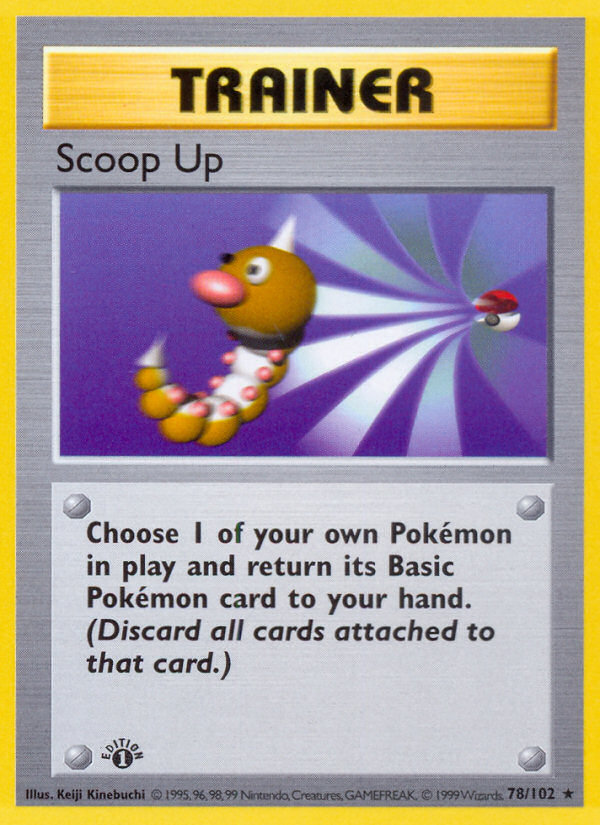

Given that there’s only six different types of Weaknesses and that Resistance is a steep –30, both Weakness and Resistance play a large role in the earliest formats. You’ll need these cards to exploit them. Scoop Up doubles as a way to heal damage, which takes us to below.
The Healing Cards


Pokémon Center is the strongest of these three healing cards, as it can not only heal the most damage, but also multiple Pokémon.
The Recovery Cards


Energy Retrieval and Item Finder are the only two cards that restore cards from the discard pile to your hand. Energy Retrieval gives you a chance at surviving Energy Removal & Super Energy Removal, while Item Finder needs no explanation in a format filled with so many strong Trainers.
Hand Disruption

Only one card (well, technically
Now that you’ve been introduced to the mightiest Pokémon in Base Set, as well as the powerful Trainers players used alongside them, let’s take a more detailed look at the Haymaker deck. Below is a typical list from 1999, before the game had seen a single expansion set.
Haymaker Deck (Base Set only, 1999)

| Pokémon (11) | Trainers (32) | Energy (17) |
| 4x 4x 3x | 4x 4x 4x 3x 3x 3x 3x 3x 3x 2x | 7x 6x 4x |
The Haymaker decks of 1999 were fast and aggressive, relying on heavy counts of PlusPower and Gust of Wind to knock out weak Basic Pokémon before they could evolve into their stronger forms. Even if an opponent managed to evolve into one of their stronger Pokémon, Energy Removal and Super Energy Removal kept it in check, and 30 or 40 damage a turn from attacks would end up being more than enough to overwhelm them.
So, what decks could compete with the Haymaker? Players tried to beat Haymaker with a variety of tricks. They used Blastoise’s Rain Dance to overcome the onslaught of Energy Removal & Super Energy Removal the Haymaker unleashed, but with Blastoise’s Weakness to Lightning, this deck usually still succumbed to Electabuzz. Some Rain Dance decks paired Blastoise with the Grass-weak (and Fighting-resistant)

Players also tried Damage Swap decks combining Alakazam and the 120 HP
The truth was there really was nothing you could construct with Base Set’s 102 cards that could consistently beat the Haymaker deck. It was too fast and its Trainers were too good. Fortunately, though, few players in 1999 caught on to how overpowered this deck actually was. Had everyone caught on, the game would have quickly gotten stale! Instead, the Base Set era achieved an equilibrium where nearly everyone was battling terrible decks against each other—most blissfully oblivious as to how bad their decks actually were. Nonetheless, with over half of the original 151 Pokémon still waiting to be made into a card, players and fans were eager for more Pokémon cards.
Jungle 

With Pokémania still running rampant, players joyously welcomed the game’s first expansion set. Named Jungle, it debuted in the US in June 1999, six months after the release of Base Set. A mere 48 cards (64 including non-holographic versions of holo cards), Jungle was not a large set, but nonetheless left players hopeful that new decks and strategies could be developed. Let’s take a look at the most impactful cards from the Jungle set.
Scyther

Given the strength of Hitmonchan, Fighting Resistance was a very valuable attribute on a Pokémon. And while there was no shortage of Fighting-resistant Pokémon in Base Set, none of them were particularly impressive. Most were either too weak or required too much Energy to attack. Those that had decent attacks, like
Jungle’s Scyther, however, was different. It boasted an impressive 70 HP, it had a zero retreat cost, and it was weak to Fire, not Lightning, meaning Haymaker decks could not hit its Weakness. Scyther’s most noteworthy feature though was that its Slash attack required only Colorless Energy, allowing it to fit into any deck. It’s for all of these reasons that Scyther is regarded by many old school players as the strongest Pokémon in the game’s first three sets.
You might expect Scyther to have been the beginning of the Haymaker deck’s demise, and while it certainly made things harder for Hitmonchan, the card’s versatility was taken advantage of by nearly every deck. This ironically included the Haymaker itself, which gained another solid Basic Pokémon to pair with Hitmonchan.
Wigglytuff

Evolved Pokémon struggled against the Haymaker deck. Hampered by Energy Removal & Super Energy Removal, they were slow to set up and required too much Energy to do too little damage. Wigglytuff, however, was a little more promising. Its Do the Wave attack could reach 60 damage, which was only one PlusPower away from scoring a one-hit KO on Hitmonchan and Electabuzz, as well as the new Scyther. Since Do the Wave required only Colorless Energy, it could be fueled by
Wigglytuff’s Fighting Weakness might seem like a major issue given that the best deck at the time played four Hitmonchan. However, Wigglytuff decks would play Scyther to contend with Hitmonchan.
Lickitung

Lickitung is a card that never got the credit it deserved back in 1999, but when players began revisiting the game’s earliest formats in 2016, they realized just how powerful it actually is. Needing only one Energy to attack, it can easily withstand Energy Removal as it delivers a series of Tongue Wrap attacks to weaken Pokémon. Its 90 HP makes for a tough KO, especially as you dish out your own Energy Removal and Super Energy Removal while it attacks.
Dodrio

Like Lickitung, Dodrio is another Pokémon that didn’t get the credit it deserved during its time, but it’s actually one of the best Evolved Pokémon from its time period. Getting stuck against a Pokémon you can’t damage is a common theme in the earliest formats. Dodrio’s Retreat Aid helps you escape this troublesome situation.
Mr. Mime

Mr. Mime’s fun and unique Invisible Wall Pokémon Power made it worth including in decks. It conveniently hit Hitmonchan’s Weakness while being untouchable by Scyther. Some decks, like Rain Dance, had limited ways to break through Invisible Wall.
Kangaskhan

Kangaskhan’s Fetch attack made it the perfect starting Pokémon for decks trying to set up evolved Pokémon. Its beefy 90 HP allowed it to survive multiple turns, ensuring you receive multiple cards from Fetch.
Jungle: What Changed?
The most successful decks following the release of Jungle were Wigglytuff decks and Haymaker. (Rain Dance decks also continued to pick up their fair share of wins.) Haymaker was shifting from a trio of Hitmonchan, Electabuzz and Farfetch’d to a trio of Hitmonchan, Electabuzz and Scyther, while Wigglytuff was being paired with a variety of Pokémon. However, unlike today, where nearly every player attending a tournament can be expected to have a strong deck, few players entering Pokémon TCG tournaments at the time were using the best decks. In fact, even a majority of the decks winning tournaments weren’t one of these strong decks. To highlight the variety of decks that continued to win local tournaments, take a look at these tournament-winning deck lists that were published in the October 1999 edition of Scyre magazine, a popular TCG magazine from the time.

As you can see, all sorts of craziness—even a duo of Charizard & Venusaur!—was still managing to win local tournaments. It’s also worth mentioning here that in 1999 these type of small, local tournaments were pretty much the only kind of tournaments that existed outside of Japan. It wasn’t until 2000 that Wizards of the Coast put together their first major tournament.
Following Jungle, Wigglytuff would continue to be a strong card, but things continued to get worse for the Haymaker deck. With the release of the second expansion set, Fossil, Hitmonchan, the star Pokémon of the Haymaker deck, finally met its match.
Fossil 

In October 1999, Pokémon’s second expansion set, Fossil, debuted. This marked a historic moment for the game as it completed all 150 of the original Pokémon existing in card form. (#151 Mew followed shortly after as a promo.) Fossil shook up the competitive metagame with some strong new Pokémon. Let’s have a look.
Mewtwo (Promo)


Although not technically part of the Fossil set, this Mewtwo was one of four promotional cards handed out to attendees of Pokémon: The First Movie in November 1999, one month after Fossil’s US debut. While Energy Removal & Super Energy Removal remained the the defining Trainers of the game, Mewtwo now became the Pokémon defining the format, with all decks needing some kind of answer to it. Mewtwo’s strength stemmed from its Energy Absorption attack, which could be used several different ways:
- It permitted players to play more aggressively, drawing through their decks with
Professor Oak andBill , since discarded Energy cards could now easily be recovered. - It formed a great combo with
Computer Search , allowing players to pitch Energy cards to then absorb and threaten a Turn 2 Psyburn. - It provided excess Energy cards to allow easy use of
Super Energy Removal (and alsoSuper Potion ).
All of these tricks made Mewtwo strong, but the fact that it was a Psychic-type Pokémon made it even better, as it could land a one-hit KO the popular Hitmonchan. Predictably, it was after Mewtwo’s release that players started making new variants of the Haymaker deck, often replacing Hitmonchan with Mewtwo or the new Magmar.
Magmar

There was already a
Ditto

Ditto’s Transform Pokémon Power made for plenty of tricky rulings questions, but more importantly, it was yet another deck-worthy Basic Pokémon. With its unique ability to use
Muk

Muk was the first card in the Pokémon TCG that offered a way to permanently disable Pokémon Powers. It paired well with Mewtwo, deactivating
Mew (Promo)
Originally released in the Fossil expansion in Japan, Wizards of the Coast thought it would be more exciting to unveil the 151st Pokémon internationally as a promotional card immediately following Fossil’s debut. Serving as an effective counter to the almighty Mewtwo, Mew’s Psywave offered a great response to Mewtwo’s Energy Absorption—all you’d need for a knockout is a Psychic Energy and a
Articuno

It wasn’t until the Fossil set that Rain Dance decks gained the perfect attacker. With Fighting resistance and no Weakness, Articuno was a great battling Pokémon that allowed for your valuable
Psyduck

Given that the best Base–Fossil decks ran 25 or more Trainer cards, Headache could easily shut opponents down as early as the first turn of the game! These Trainer-less turns would give you an opportunity to build your Pokémon without fear of Energy Removal & Super Energy Removal, or sneaky PlusPower KOs from your opponent.
The Base–Fossil Format

After the Fossil set, more new decks emerged. With a larger variety of strong Basic Pokémon to now choose from, the term Haymaker began being used to refer to a variety of decks that relied on any duo of them, not just Hitmonchan & Electabuzz. These Haymaker variants battled it out with Wigglytuff and newly improved Rain Dance decks, while other players got crafty with the new
Playing the 1999 Base–Fossil Format
In spite of its overpowered Trainers, the Base–Fossil format is both skill-intensive and fun. And while there’s no rule against playing with only Base Set (or just Base Set & Jungle), the most popular way to enjoy the 1999 format is by playing with all three of the game’s first sets: Base Set, Jungle and Fossil (plus the first nine of the Wizards promo cards, which were legal during this time). This format, called Base–Fossil (read as Base to Fossil) not only offers a card for each of the first generation of Pokémon, but also more viable decks and strategies than the formats that preceded it. Some of its best decks and strategies weren’t even discovered until over 20 years later!
If you’re looking for the unique rules for the 1999 format, you can view those here.
The Decks
Here you’ll find 10 of my favorite decks for the Base–Fossil format, followed by a link to more. Each deck list contains tips for playing it. Beneath the decks you’ll find additional tips for general playing.
- Alakazam/Mr. Mime/Chansey


- Arcanine/Electrode


- Clefable/Hitmonchan/Dodrio


- Hitmonchan/Dodrio/Mewtwo

- Dragonite/Dodrio/Hitmonchan

- Haymaker


- Lickitung/Scyther/Mr. Mime

- Rain Dance


- Venusaur/Dodrio

- Wigglytuff/Magmar/Dodrio


- Additional Decks
Alakazam/Mr. Mime/Chansey 


🌠 Iconic Deck

| Pokémon (21) | Trainers (22) | Energy (17) |
| 4x 3x 3x 3x 2x 2x 2x 2x | 4x 3x 3x 3x 2x 2x 2x 1x 1x 1x | 9x 4x 4x |
Alakazam’s Damage Swap continuously heals Mr. Mime, making it impossible to KO as long as its Invisible Wall Pokémon Power is working. Chansey and other high-HP Basics serve to absorb damage, while Scyther and Kangaskhan function as alternate attackers to deal with the Psychic-resistant Pokémon Mr. Mime can’t damage. Though you’ll win many games by running your opponent out of cards, this deck definitely has the capability to draw six prize cards.
Tip: Use Psyduck’s Headache to protect Abra from Gust of Wind, allowing you the vital turn to evolve it.
Arcanine/Electrode 


| Pokémon (19) | Trainers (31) | Energy (10) |
| 4x 4x 4x 3x 3x 1x | 4x 4x 4x 4x 3x 2x 2x 2x 2x 2x 1x 1x | 6x 4x |
You’ll usually have to rummage through much of your deck on the first turn, trying to get both a Voltorb and Growlithe benched before ideally ending your turn with Psyduck’s Headache. Headache will prevent your opponent from searching for additional Basic Pokémon as the threat of Electrode’s Buzzap powering up Arcanine looms over them. Once Arcanine is built, Lass will strip away your opponent’s Energy Removal cards, clearing the path for Arcanine to mow down your opponent’s Pokémon with Take Down.
Tip: Rely on Gastly’s Lick as a way to damage Mr. Mime.
Clefable/Hitmonchan/Dodrio 


| Pokémon (18) | Trainers (27) | Energy (15) |
| 4x 3x 3x ERRATAMetronome must still do anything required to use the attack, such as discarding Energy cards.
Click to view Errata Page3x ERRATAMetronome must still do anything required to use the attack, such as discarding Energy cards.
Click to view Errata Page3x 2x | 4x 4x 4x 3x 2x 2x 2x 2x 2x 1x 1x | 11x 4x |
Clefable and Hitmonchan can each launch effective attacks for a single Energy, which make them great against Energy Removal & Super Energy Removal. But since both of these Pokémon can be stumped easily (Hitmonchan by Fighting-resistant Pokémon and Clefable by weak attackers), you’ll need a way to easily switch them out. That’s where Dodrio’s Retreat Aid comes in handy, allowing you to easily find the right attacker for the moment. With this easy ability to retreat, you can move damaged Pokémon to the Bench, then use Pokémon Center to heal multiple Pokémon at once.
Tip: Re-enact Electabuzz’s battle cry each time you defeat an opponent’s Dodrio with Electabuzz’s Quick Attack.
Revised on 10/27/2023: –1 Chansey, –1 Fighting Energy, +2 Electabuzz
Hitmonchan/Mewtwo/Dodrio 

| Pokémon (16) | Trainers (28) | Energy (16) |
| 4x 3x 4x 2x 2x 1x | 4x 4x 3x 3x 3x 3x 2x 2x 1x 1x 1x 1x | 8x 7x 1x |
Hitmonchan hits Lickitung and Electabuzz for Weakness, while Dodrio allows you to easily retreat to your Psychic-type Pokémon to deal with Mewtwo.
Revised on 10/27/2023: –3 Machop, –1 Mew, –1 Super Energy Removal, –1 Energy Search, –1 Scoop Up, +1 Doduo, +2 Hitmonchan, +1 Mr. Mime, +1 Bill, +1 Energy Removal, +1 Mr. Fuji
Dragonite/Dodrio/Hitmonchan 
🤡 Fun to Play

| Pokémon (23) | Trainers (20) | Energy (17) |
| 4x 3x 3x 4x 3x 2x 2x 1x 1x | 4x 4x 3x 2x 2x 2x 1x 1x 1x | 9x 4x 4x |
This multi-Evolution deck relies on Kangaskhan’s Fetch (and sometimes Lickitung’s Tongue Wrap) to enable you to set up a Dragonite & Dodrio on your Bench. From there, you can use Dragonite’s Step In to escape whatever status effects your opponent places on your Active Pokémon, then use Dodrio’s Retreat Aid to free retreat into whichever attacker suits the situation best. This duo is particularly effective against Lickitung decks, which rely on repeatedly stalling you with Paralysis to eventually deck you out.
Revised on 10/27/2023: –1 Lickitung, –1 Potion, –4 Fighting Energy, +1 Mr. Mime, +1 Lass, +4 Psychic Energy
Haymaker 
🌠 Iconic Deck

| Pokémon (11) | Trainers (32) | Energy (17) |
| 3x 3x 3x 2x | 4x 4x 4x 3x 3x 3x 3x 2x 2x 2x 1x 1x | 7x 6x 4x |
The Haymaker deck’s single-Energy attacks apply pressure quickly, while Scoop Up (and a single Switch) allow you to maintain this pressure when you encounter Resistance. Ditto gives the deck a way to deal with
Tip: Play Lass to prevent your opponent from using a Trainer card that would allow their higher retreat cost Pokémon to escape and avoid a knockout.
Lickitung/Scyther/Mr. Mime 

🏆 Top Deck

| Pokémon (15) | Trainers (27) | Energy (18) |
| 4x 3x 2x 2x 1x 1x 1x 1x | 4x 4x 4x 4x 4x 3x 1x 1x 1x 1x | 13x 1x 4x |
The damage from Lickitung’s Tongue Wrap adds up quickly, particularly when your opponent is prevented from fighting back because of Paralysis. As Lickitung’s HP is depleted, Scoop Up allows you to save it, opening the door for you to finish off a damaged Pokémon with Scyther’s Slash or Mr. Mime’s Meditate.
Tip: If you are in danger of decking out, use Mewtwo’s Energy Absorption (repeatedly if necessary), then retreat to the Bench, where Mewtwo can be shuffled back into the deck with Mr. Fuji.
Revised on 10/27/2023: –2 Computer Search, –1 PlusPower, –1 Defender, +1 Psyduck, +1 Professor Oak, +1 Energy Retrieval, +1 Psychic Energy
Rain Dance 

🌠 Iconic Deck

| Pokémon (12) | Trainers (34) | Energy (14) |
| 4x 1x 3x 4x | 4x 4x 4x 4x 4x 3x 2x 2x 2x 2x 1x 1x 1x | 14x |
With 70 HP and no Weakness, Articuno was the partner Blastoise always wanted. Articuno’s Freeze Dry sets up any Pokémon with 80 HP or less for a two-hit KO, while Blastoise’s Rain Dance provides plenty of extra Energy for Super Energy Removal & Super Potion.
Tip: Use Maintenance before playing Professor Oak, preserving cards like Item Finder & Energy Retrieval for later in the game.
Venusaur/Dodrio 

| Pokémon (21) | Trainers (21) | Energy (18) |
| 4x 3x 3x 4x 3x 3x 1x | 4x 4x 2x 2x 2x 2x 1x 1x 1x 1x 1x | 17x 1x |
Kangaskhan’s Fetch will assist you in evolving Bulbasaur and Doduo while you accumulate Grass Energy in play. After Kangaskhan has done its job, you can begin launching Solarbeam attacks from Venusaur, and if all has gone well, even retreat between Venusaurs with Dodrio’s Retreat Aid. As your board piles up with damage, Venusaur’s Energy Trans allows you to deliver the coup de grâce: a damage-clearing Pokémon Center that leaves all your Energy untouched.
Tip: When attempting to power up a Solarbeam attack, use Energy Trans to spread your Energy cards out to one per Pokémon. This will prevent your opponent from discarding two of your Energy cards with Super Energy Removal.
Revised on 10/27/2023: –1 Scyther, –1 Ivysaur, –1 Pokémon Center, –1 PlusPower, –1 Double Colorless Energy, +1 Kangaskhan, +1 Mr. Fuji, +3 Grass Energy
Wigglytuff/Magmar/Dodrio 

🏆 Top Deck

| Pokémon (18) | Trainers (25) | Energy (17) |
| 4x 3x 4x 3x 4x | 4x 4x 4x 3x 2x 2x 2x 2x 1x 1x | 13x 4x |
Magmar’s Smokescreen buys turns needed to set up Wigglytuff and a full Bench, while Smog allows you to apply pressure against pesky Lickitung decks. With help from Dodrio’s Retreat Aid, Wigglytuff can fall back to safety on the Bench after being hit with Super Energy Removal, allowing you to rebuild.
Tip: Use Magmar’s Smokescreen to place high-HP Pokémon in one-hit KO range of Do the Wave.
Revised on 10/27/2023: –4 Scyther, –1 Item Finder, –1 PlusPower, –1 Super Potion, –1 Lass, –1 Computer Search, +4 Doduo, +3 Dodrio, +1 Pokémon Trader, +1 Fire Energy
Additional Decks


If you weren’t satisfied with 10 deck lists, here’s a link to 11 more.
Tips for Winning in the Base–Fossil Format
Base–Fossil is a format that requires both patience and practice. Most match-ups will test your ability to preserve cards for an opportune moment. Some cards will be worth playing immediately, while others might be better held until the game’s final turn over 100 turns later. (Yes, Base–Fossil games can exceed 100 turns!) Spend cards too quickly and you’re guaranteed to deck out in any type of prolonged game. Hold cards for too long, though, and you risk being overpowered by your opponent. This type of conservationist approach required to be a strong Base–Fossil player is in stark contrast to modern Pokémon formats, where most decks burn through several Item cards in the first few turns. This difference is one of the reasons players who play modern Pokémon can find Base–Fossil refreshing, but also challenging at the same time. Here are some tips that will help you win more games in the Base–Fossil format.
#1 Be careful with Professor Oak
Break the habit of thinking you have to play a draw card each turn, as you may be accustomed to with Supporter cards in today’s formats. Being careless with Professor Oak is a surefire way to ensure a loss by deckout. In the Base–Fossil format, it’s sometimes correct to hold off on playing a Professor Oak just to preserve a single card!
#2 Avoid attaching energy to heavily-damaged Pokémon
Considering many of your Energy cards will be discarded by Energy Removal & Super Energy Removal, it’s important to make all of your Energy cards count. Rather than continue attaching Energy to a heavily damaged Pokémon, it’s often best to give up on that Pokémon and start attaching these Energies to a fresh one instead.
#3 Pay attention to deck count
Deck counts are hugely important in the 1999 formats. Before playing a draw card like Professor Oak, you should know whether you or your opponent will have more cards left in their deck. If your opponent will have more cards in their deck than you, the pressure is on you to create a path to draw all six Prizes. If you do not have a path to six Prizes, you may be forced to hold off on drawing additional cards.
#4 Keep Basic Pokémon (and other cards) safe in your hand
No cards in the the Base–Fossil format strip Pokémon from your hand, so it’s often advantageous to keep Basic Pokémon in your hand until you are ready to attach Energy to them. Keeping these Pokémon in your hand not only retains the option to discard them for a much needed Item Finder, Computer Search, or Energy Retrieval, but also keeps your opponent guessing as to what options are available to you.
#5 Don’t be discouraged!
Though Base–Fossil games tend to develop into lengthy and skillful battles, the format is not immune from some quick and unpreventable losses. You will occasionally be handed a quick defeat from an early Lass or barrage of PlusPowers, but since these matches are all in fun, there’s no need to lose sleep over it! Unlike at a tournament, where a quick loss leaves you wandering the tournament hall, desperately searching for someone to listen to your sour grapes, casual play always allows you to simply shuffle up your cards and start a new game. If you keep playing this format, I promise you will enjoy many great matches.
Fun Match-Ups
Here are some of my favorite Base–Fossil match-ups to play. Each of these is close to even, so they serve as a fun way to try the format out with a friend.
- Lickitung/Scyther/Mr. Mime vs Hitmonchan/Mewtwo/Dodrio
- Lickitung/Scyther/Mr. Mime vs Wigglytuff/Magmar/Dodrio
- Lickitung/Scyther/Mr. Mime vs Dragonite/Dodrio/Hitmonchan
- Lickitung/Scyther/Mr. Mime vs Hitmonchan/Magmar/Dodrio (Page 2)
- Lickitung/Scyther/Mr. Mime vs Magmar/Arcanine (Page 2)
- Hitmonchan/Mewtwo/Dodrio vs Venusaur/Dodrio
- Hitmonchan/Mewtwo/Dodrio vs Rain Dance
- Lickitung/Moltres (Page 2) vs Wigglytuff/Magmar/Dodrio
- Lickitung/Moltres (Page 2) vs Wigglytuff/Mewtwo (Page 2)
- Lickitung/Moltres (Page 2) vs Dragonite/Dodrio/Hitmonchan
Tips for Playing Against Mewtwo
When two Mewtwo decks against each other, the first player to use Energy Absorption will generally be at an advantage since they can then use Gust of Wind to knock out any other Mewtwos. However, there are a few effective ways to deal with your opponent powering up Mewtwo first:
- Send a Mew active and slam down a
PlusPower to Psywave for a one-hit KO. (If you don’t have the PlusPower, look for a way to first deal 10 to Mewtwo, putting it in range for the Psywave KO.) - Play
Super Energy Removal on Mewtwo, then use Energy Absorption yourself, threatening a KO. (Your opponent will often respond the same way, in which case whoever blinks first by missing an SER surrenders the KO.) - Attach an Energy card to a benched Ditto, threatening a knockout next turn with a Double Colorless Energy. Your Ditto will be vulnerable to Gust of Wind, so consider an attack like Smokescreen or Thundershock to give Ditto a better chance at surviving until next turn.
Tips for Playing Against Ditto
Ditto is another popular card in the Base–Fossil format and you can exploit it in one of three ways:
- Once you’ve accumulated 50 damage on your opponent’s active Ditto, use Gust of Wind to send it to the Bench, disabling Transform and scoring an immediate KO.
- Send up a low HP Pokémon to score easy KOs against Ditto, since Ditto will inherit its low HP. (A
Rattata works as a clever anti-Ditto card.) - Lower Ditto’s HP to 50 with Sleep or Paralysis, disabling Transform. (For example, you can KO a Ditto holding 40 damage by hitting Heads on Electabuzz’s Thundershock.)
If you’re playing Ditto yourself, you’ll want to deal with any low HP Pokémon before you attack with it. If your active Ditto has accumulated 50+ damage and is only surviving because the Defending Pokémon has high HP, you’ll usually want to play a
Heading into 2000

After the first two expansion sets, the Pokémon TCG seemed to be in a good place. Some variety had begun to emerge in decks, particularly with the Pokémon, and the game was both fun to play and skill-oriented. Surprisingly, however, the interactive and skill-based nature of the game took a steep and year-long decline beginning with the Team Rocket expansion in 2000, when one powerful Trainer card all but took over the game.
Base–Fossil | Base–Team Rocket