Table of Contents
- Introduction
- The Game Changers
- 2000 West Coast STS
- Playing Base–Rocket
- Base–Rocket: Legal Sets & Cards
- Base–Rocket Decks
- Fun Match-Ups
- Closing Thoughts
- Next Up: The Gym Sets


Introduction
In April 2000, the Team Rocket expansion hit the shelves in stores across the United States, bringing with it two cards that could each drastically limit your opponent’s ability to do, well, pretty much anything. If you played Pokémon all the way back in 1999 or if you’ve already read about the 1999 Base–Fossil era, you’ll know that the earliest years of the game were filled with powerful Trainer cards, like
The Game Changers
Let’s look at the two Trainer-denying options that debuted in Team Rocket, permanently changing the way Pokémon was played.
Rocket’s Sneak Attack

Going first in the 1999 formats was definitely an advantage, especially after the release of the movie promo

Before Rocket’s Sneak Attack, the only way to shuffle away your opponent’s Trainer cards was with Lass, which shuffled all Trainers from each player’s hand back into their decks. Lass hit the brakes for both players, not just the opponent, and if it was played on the first turn of the game, it was usually difficult for the player who played it to follow up with a hefty attack on the turns that immediately followed. After all, without Trainer cards, it’s difficult to continue setting up.
But with Rocket’s Sneak Attack, the Trainer denial became one-sided. Now you could strip away an opponent’s best draw card, whether it was Professor Oak, Computer Search or Bill, while leaving your own intact. If your opponent held multiple draw cards, you could continue drawing through your deck, seeking out any additional Rocket’s Sneak Attacks needed to strip away these remaining Trainers. All the while, you could still prepare a powerful attack, like Wigglytuff’s Do the Wave, for the following turn.
With the release of Rocket’s Sneak Attack, many games started to follow the same pattern: the player that won the opening flip would rummage through their deck in search of enough Rocket’s Sneak Attacks to strip away all of the opponent’s card-drawing Trainers, then try to quickly beat them before they could re-draw any of these cards. Playing second, you were on the other side of it, hoping your opening hand contained enough Basic Pokémon to survive long enough to recover from Rocket’s Sneak Attack. Pokémon matches in 2000 were constantly (and I mean constantly) decided by how quickly—or rather, simply whether or not—the player on the receiving end of Rocket’s Sneak Attack could top-deck a Professor Oak or Computer Search to get back into the game. One of the ways players tried to counter Rocket’s Sneak Attack was to include additional high-HP Basic Pokémon in their decks, which would of course give them more turns to recover. However, as is the case in card games, players remained at the mercy of luck trying to draw these extra Pokémon in their opening hand.
Nearly everyone that played Pokémon back in 2000 will agree that Rocket’s Sneak Attack was a card that took the game in the wrong direction, but this card was only half of the problem with the Team Rocket set.
Dark Vileplume


As if Rocket’s Sneak Attack wasn’t enough, Dark Vileplume and its incredible Hay Fever Pokémon Power debuted in the same set! This meant that you could use Rocket’s Sneak Attack on the first turn to strip away your opponent’s useful Trainers, then follow up with a Dark Vileplume as quickly as the second turn. In doing so, you all but guaranteed your opponent would never play a Trainer card over the course of the game. The only real counter to Dark Vileplume was Fossil‘s Muk, but because of Rocket’s Sneak Attack (or Psyduck’s Headache), you might never even have a chance to get a Grimer in play before being exposed to Hay Fever.
Dark Vileplume, like Lickitung in 1999, did not receive the credit it deserved. While it definitely saw play, its full potential wasn’t realized, perhaps because players never really developed an optimal list for it. But after revisiting the format, it is clear that Dark Vileplume decks are the decks to beat in Base–Rocket. If you plan to play, you’ll want to fit Muk into most of your deck lists to give yourself a shot against it.
There’s a few other impactful cards that debuted in Team Rocket. Props to these cards, as they managed to not single-handedly ruin the game.
Nightly Garbage Run

It might be hard to believe, but it wasn’t until Pokémon’s third expansion that we finally received a card that could shuffle Pokémon and Energy from the discard pile into back into the deck. Nightly Garbage Run helped prevent deck outs, undoing some of the wastefulness of those aggressive first turns where players dug through their deck in search of Rocket’s Sneak Attack and/or more Basic Pokémon. It also is your most effective counter against stall decks, allowing Energy cards that have been stripped away by Energy Removal & Super Energy Removal to be recycled into your deck.
Imposter Oak’s Revenge

Imposter Oak’s Revenge was one of the more balanced hand disruption cards, as your opponent would usually retain some options when given four cards. But the best way to play it was when your opponent had too many cards in their hand for Rocket’s Sneak Attack to be effective. You would first play Imposter Oak’s Revenge to reduce your opponent’s hand to 4 cards, then play Rocket’s Sneak Attack, hoping to catch them with only one useful Trainer in hand.
Rainbow Energy

The Rainbow Energy we know today first made its debut in the Team Rocket set in 2000. Back then, though, the 10 damage it inflicted was a much bigger deal. Rainbow Energy increased the viability of 3-type decks and was particularly strong in decks that played Movie Promo Mewtwo, as it would not deal damage when attached via Mewtwo’s Energy Absorption attack.
2000 West Coast Super Trainer Showdown


In July 2000, Wizards of the Coast hosted their first of four Super Trainer Showdown events. This was the first major international event for the Pokémon TCG, and it drew over 6000 fans from around the world. Unfortunately, space was limited aboard The Queen Mary ship the event was hosted on, and less than 1000 were permitted on it to play. Just as they are today, players were separated into three age divisions: 10–, 11–14 and 15+. They would battle in the Base–Rocket format.

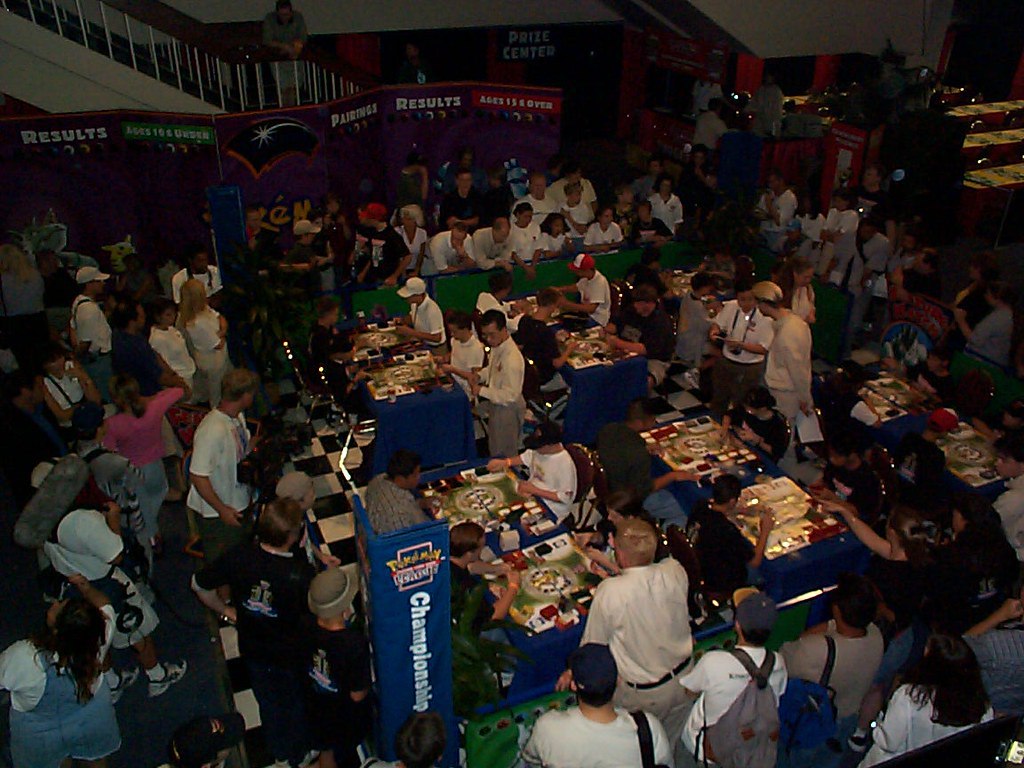
Though players were slow to catch on to the best decks and strategies during the first year of the game, by the time the first Super Trainer Showdown took place, the game had existed internationally for over a year and a half and players were starting to get it. Their decks rarely played the silly Pokémon we saw during the Base & Jungle era, and instead we saw more Haymaker variants and Wigglytuff decks that utilized the overpowered Trainers of Base Set. Let’s break down the winning decks from the first Super Trainer Showdown.
Andrew Marshall’s Hitmonchan/Mewtwo Deck
🥇 1st Place, 2000 WCSTS, 15+ Division
| Pokémon (13) | Trainers (30) | Energy (17) |
| 3x 3x 2x 2x 2x 1x | 4x 4x 3x 3x 3x 2x 2x 2x 2x 2x 2x 1x | 7x 6x 4x |
Andrew Marshall’s STS-winning deck was fast and aggressive, maxing out on both Professor Oak and Bill and still fitting three copies of Computer Search. However, Marshall opted against Rocket’s Sneak Attack. Since his deck was composed entirely of Basic Pokémon with Energy-efficient attacks, it’s not like he needed it. Instead, Marshall played Lickitung, a Pokémon that could be used to buy turns to recover from an opposing Rocket’s Sneak Attack.
Jack Savage’s Mewtwo/Electabuzz Deck
🥇1st Place, 2000 WCSTS, 11–14 Division
| Pokémon (14) | Trainers (30) | Energy (16) |
| 4x 3x 3x 2x 2x | 4x 4x 3x 3x 3x 3x 3x 3x 2x 2x | 6x 6x 4x |
11–14 division winner Jack Savage had a similar thought process to 15+ winner Andrew Marshall: he maxed out on Professor Oak and Computer Search in order to quickly fuel Mewtwo’s Energy Absorption. However, Savage opted to go harder on offense by running three copies of Rocket’s Sneak Attack. Savage, like Marshall, also included a Pokémon to defend against Rocket’s Sneak Attack: Chansey. The beauty of Chansey, though, was that it could be used both on offense and defense; not only could it be used to buy turns to recover from an opposing Rocket’s Sneak Attack, it could also deliver a Double-edge attack for a pivotal late-game KO.
Super Trainer Showdown: End Result
By the time the Super Trainer Showdown was over, the theme of the Pokémon TCG was becoming clear: this was a game of big Basic Pokémon and powerful Trainer cards. Across the age divisions, exactly one half of the Top 8 decks played not a single Evolution card, while all but two of the remaining half had Wigglytuff as its lone evolution. The big Basic decks that won the 15+ and 11–14 divisions each ran a whopping 30 Trainers, meaning only half of their deck space was used for Pokémon and Energy. This left players asking: was this really how the game was supposed to be?
This first Super Trainer Showdown can be viewed as the catalyst to the collective frustration players would feel with the game. It wasn’t just the fact that a huge element of the franchise, evolving your Pokémon, was almost non-existent in the card game. It was also the fact that the Trainer cards were so oppressive.

These feelings were understandable. It was different when Pokémon was only being casually played in comic book stores with little to nothing on the line. But now, things were getting more serious. People were traveling long distances to compete. And when their hand was stripped on the first turn leaving them defenseless against a quick loss, they hardly felt like they got to play. Wizards commiserated. Following this first Super Trainer Showdown they started flirting with their own ideas to “fix” the game.
Playing Base–Rocket
The Base–Team Rocket format (Base–Rocket, for short) is the last format before Stadium cards debuted and for this reason it can be considered the final phase of true classic Pokémon. One huge plus of this format is that decks gain access to Nightly Garbage Run, a crucial tool to defend against deck out. If you’ve played the Base–Fossil format that preceded the Team Rocket set, you’ll know that many games end in a deck out, something that can be frustrating for new players that are just learning.
Unfortunately, the addition of Nightly Garbage Run comes at a steep cost: it emerges alongside the oppressive Rocket’s Sneak Attack and Dark Vileplume. So while you’re certainly going to lose fewer games to deck out in Base–Rocket than you would playing Base–Fossil, you’ll now instead lose a lot more games where you feel like you didn’t even get to play. Even though about 95% of the cards you’ll see in Base–Rocket decks are used in Base–Fossil, these two cards single-handedly warp the format, removing a lot of the skillful interaction that existed before their entrance.
That said, depending on the decks you play with and against, Base–Rocket can still produce games that are as fun, skill-based and interactive as the Base–Fossil format. And with Nightly Garbage Run to shuffle Energy and Pokémon back into the deck, beginners are less likely to deck themselves as they learn. In the sets that followed, the trend of overpowered Trainers and hand disruption only gets worse, so consider Base–Rocket a chance to enjoy classic Pokémon before things got really out of hand.
Base–Rocket: Legal Sets & Cards
Base–Rocket includes Base Set and the game’s first three expansion sets, plus the first 16 Wizards Black Star Promos.
- Base Set
 Jungle
 Fossil
 Team Rocket
 Wizards of the Coast Promotional Cards #1–16
If you’re looking for the unique rules of the Base–Rocket format, remember that all Wizards of the Coasts formats use the same rules. You can view them here.
The Decks
Below are 14 decks built for the Base–Rocket format. Some, like Wigglytuff/Magmar, look nearly identical to their previous versions, only adding Nightly Garbage Run and sometimes Muk. Others, like Venusaur, gain a few tricks with cards from Team Rocket.
The remaining decks all take aggressive approaches that are designed to beat your opponent quickly. Dark Vileplume/Snorlax does this by immediately hindering the opponent with Psyduck’s Headache. Buzzap/Potpourri, Mewtwo/Hitmonchan and Wigglytuff Sneak Attack all accomplish this by delivering quick pressure alongside Rocket’s Sneak Attack.
Alakazam/Dark Vileplume/Kangaskhan 


🏆 Top Deck

| Pokémon (28) | Trainers (21) | Energy (11) |
| 4x 3x 3x 4x 3x 3x 4x 3x 1x | 4x 4x 4x 4x 4x 1x | 4x 4x 3x |
After enough Fetch attacks from Kangaskhan, this 90 HP Pokémon can become an attacking beast after setting up Dark Vileplume and Alakazam in play. Unable to play Trainers, your opponent will be helpless as you use Alakazam’s Damage Swap to move damage off of your Active Pokémon and onto your high HP Benched Pokémon, like Chansey (or another Kangaskhan). The deck will crumble to Muk’s Toxic Gas, but if your opponent doesn’t play Muk, you are almost sure to win if you pull off this setup.
Tip: Use Rainbow Energy to knock out your own Dark Vileplume to give yourself a key turn of Trainers.
Buzzap Potpourri 


🤡 Fun to Play

| Pokémon (17) | Trainers (36) | Energy (7) |
| 4x 4x 2x 2x 2x 1x 1x 1x | 4x 4x 4x 4x 4x 4x 2x 2x 2x 2x 1x 1x 1x 1x | 4x 3x |
With 4 PlusPower and the ability to hit five different Weaknesses, this deck can land a first-turn KO against most Basic Pokémon, all while Rocket’s Sneak Attack strips away the opponent’s best Trainer cards. But it’s the deck’s second turn that’s even more impressive, where it continues to attack our opponent’s Weakness by using Buzzap to power up whichever Pokémon is best for the job. Rocket’s Sneak Attack continues to shine here, preventing your opponent from utilizing any Trainers they might find with the Prize cards Buzzap gives them. In the turns that follow, Double Colorless Energy prepares Chansey for the final game-winning KOs, often defeating your opponent before they can even process what happened.
Clefable/Mewtwo 

| Pokémon (17) | Trainers (31) | Energy (12) |
| 4x 3x ERRATAMetronome must still do anything required to use the attack, such as discarding Energy cards.
Click to view Errata Page3x ERRATAMetronome must still do anything required to use the attack, such as discarding Energy cards.
Click to view Errata Page3x 2x 2x | 4x 3x 3x 3x 3x 3x 3x 3x 2x 2x 2x | 8x 4x |
Attacking for a single Energy, Clefable is a great Pokémon to use both with and against Super Energy Removal. After Energy Removal & Super Energy Removal deplete much of your opponent’s Energy, their best bet is usually to go for Mewtwo’s Energy Absorption. Good thing Clefable resists Psychic!
Dark Vileplume/Snorlax 
🏆 Top Deck

| Pokémon (23) | Trainers (19) | Energy (18) |
| 4x 2x 4x 3x 3x 3x 2x 2x | 4x 4x 4x 2x 2x 2x 1x | 9x 4x 3x 2x |
Aim for a Turn 1 Headache from Psyduck, then follow up by evolving into Dark Vileplume, never giving your opponent a chance to play a single Trainer card. Snorlax functions as a great attacker with Dark Vileplume in play, safe from Energy Removal & Super Energy Removal, while its Thick Skinned Pokémon Power allows you risk-free attempts at Dark Gloom’s Pollen Stench.
Tip: Use Dark Gloom’s Pollen Stench to disable an opposing Mr. Mime’s Invisible Wall.
Dodrio Potpourri 


| Pokémon (15) | Trainers (30) | Energy (15) |
| 3x 3x 3x 3x 2x 1x | 4x 3x 3x 3x 3x 3x 3x 2x 2x 1x 1x 1x 1x | 5x 3x 3x 4x |
Running three types wasn’t practical before Team Rocket, but thanks to Rainbow Energy, it finally became feasible. Using Dodrio’s Retreat Aid, you can easily switch between Hitmonchan, Mewtwo and Electabuzz to target three different Weaknesses. While Muk can make things harder on you, its Psychic Weakness allows Mewtwo to one-hit KO it with a Gust of Wind + Psyburn.
Dragonite/Dodrio/Hitmonchan 
🤡 Fun to Play

| Pokémon (22) | Trainers (21) | Energy (17) |
| 3x 3x 3x 4x 3x 2x 2x 2x | 4x 3x 2x 2x 2x 2x 2x 1x 1x 1x 1x | 13x 4x |
The concept of this deck began in the Base–Fossil format, but you can make the argument that the deck is even stronger in Base–Rocket. That’s because both Kangaskhan and Lickitung are great defenses against Rocket’s Sneak Attack. Just like in Base–Fossil, your strategy will be to use these two Pokémon to draw cards and buy the turns needed to set up a Dragonite and Dodrio. From there, you can Step In with Dragonite, removing any status effects your opponent has placed on your Active Pokémon, then use Dodrio’s Free Retreat Aid to free retreat to whichever Pokémon is best suited to attack.
Lickitung/Moltres 

🏆 Top Deck 🤹♂️ Difficult to Play

| Pokémon (18) | Trainers (25) | Energy (17) |
| 4x 3x 2x 2x 2x 2x 2x 1x | 4x 4x 4x 3x 3x 3x 1x 1x 1x 1x | 11x 2x 4x |
You’ll have a little more trouble decking out opponents in Base–Rocket now that they have access to Nightly Garbage Run, but you can offset this by using your own Nightly Garbage Run to recycle Fire Energies to build Moltres’s Wildfire. Muk’s Toxic Gas comes up huge, allowing the deck to unleash its heavy arsenal of Energy Removal cards through
Revised on 11/16/2023: –1 Moltres, –1 Professor Oak, –1 Super Energy Removal, –1 Item Finder, –2 Pokémon Center, –1 Computer Search, –1 Nightly Garbage Run, –1 Full Heal, –3 Fire Energy, +3 Scyther, +2 Magmar, +2 Energy Retrieval, +1 PlusPower, +4 Double Colorless Energy
Lickitung/Scyther 
🏆 Top Deck

| Pokémon (14) | Trainers (30) | Energy (16) |
| 3x 2x 2x 2x 1x 1x 1x 1x 1x | 4x 4x 4x 4x 3x 2x 2x 2x 2x 1x 1x 1x | 11x 4x 1x |
Lickitung remains strong in Base–Rocket, especially since its high-HP Basic Pokémon are a robust defense against Rocket’s Sneak Attack. However, you’ll need to fit a 2/2 Muk line in order to unleash your heavy ER/SER line against Dark Vileplume decks. With Muk in the deck, we no longer play Mr. Mime.
Magmarbuzz 
🌠 Iconic Deck

| Pokémon (12) | Trainers (30) | Energy (18) |
| 4x 3x 3x 2x | 4x 4x 4x 4x 3x 2x 2x 2x 2x 2x 1x | 9x 6x 4x |
One of the reasons Magmarbuzz, which originated in the Base–Fossil format, continues to be good in Base–Rocket is that both Electabuzz and Magmar have the ability to buy critical turns following Rocket’s Sneak Attack hitting your hand.
Mewtwo/Hitmonchan

| Pokémon (10) | Trainers (37) | Energy (13) |
| 4x 3x 1x 1x 1x | 4x 4x 4x 4x 3x 3x 3x 3x 3x 2x 2x 2x | 4x 3x 4x 2x |
This highly aggressive deck is able to easily pitch Energy into the discard pile, weakening the opponent’s hand with a combination of Imposter Oak’s Revenge & Rocket’s Sneak Attack before using Mewtwo’s Energy Absorption to threaten a Turn 2 Psyburn. Scoop Up allows you to easily switch Mewtwo into Hitmonchan and hit Psychic-resistant Pokémon for Weakness, giving your opponent fewer turns to draw out of the assault you’ve delivered against their hand.
Rain Dance 

🌠 Iconic Deck

| Pokémon (12) | Trainers (34) | Energy (14) |
| 4x 1x 3x 4x | 4x 4x 4x 3x 3x 2x 2x 2x 2x 2x 2x 1x 1x 1x 1x | 14x |
Rain Dance’s most significant gain in the Base–Rocket format is Computer Error, which allows it to accumulate a large hand that can go off on the following turn. While Computer Error also helps your opponent, Rain Dance benefits more from a large hand as it can attach multiple Energy cards per turn.
Wigglytuff/Magmar 
🏆 Top Deck

| Pokémon (16) | Trainers (28) | Energy (16) |
| 4x 3x 3x 2x 2x 2x | 4x 4x 3x 3x 3x 3x 2x 2x 2x 1x 1x | 12x 4x |
You’ll notice that this deck list is nearly identical to the Base–Fossil list. But while it opts to take advantage of Team Rocket‘s Nightly Garbage Run, it chooses to forego Rocket’s Sneak Attack. That’s because Magmar’s low damage output would give the opponent too many turns to recover from early hand disruption. Instead, this deck opts to play more defensively, using Magmar’s Smokescreen to both buy turns to recover from opposing Rocket’s Sneak Attacks and also set up Wigglytuff with a full Bench.
Wigglytuff Sneak Attack
🌠 Iconic Deck

| Pokémon (14) | Trainers (37) | Energy (9) |
| 4x 3x 4x 2x 1x | 4x 4x 4x 4x 4x 4x 3x 3x 2x 2x 1x 1x 1x | 2x 4x 3x |
This hyper-aggressive Wigglytuff deck has the draw it needs to easily find multiple Rocket’s Sneak Attacks to cripple your opponent’s hand on the first turn. (If you’ve taken a mulligan or two, you might need to hit them with an Imposter Oak’s Revenge first.) On Turn 2, you’ll deliver Do the Wave attacks that, with the help of PlusPower, easily land one-hit KOs against most Pokémon. As your opponent desperately hopes to topdeck out of the mess you’ve put them in, you can use Mankey’s Peek to keep an eye on the top card of their deck. When you spot something good, a follow-up Rocket’s Sneak Attack can shuffle their deck, keeping these useful cards out of your opponent’s reach.
Venusaur 

| Pokémon (23) | Trainers (21) | Energy (16) |
| 4x 3x 3x 4x 3x 3x 1x 1x 1x | 3x 3x 3x 2x 2x 2x 2x 2x 1x 1x | 12x 4x |
Venusaur benefits from the addition of Rainbow Energy as it can freely move this card with Energy Trans. Rainbow Energy allows Mewtwo to recover Energy from the discard pile with Energy Absorption, helping you fight back against Super Energy Removal. In addition to recovering Energy, Mewtwo also offers the deck a convenient answer to Muk, delivering a one-hit KO on it with its Psyburn attack.
Fun Match-Ups
You’ll notice I don’t include a Dark Vileplume deck in these, as they tend to create very one-sided match-ups that aren’t interactive.
- Wigglytuff/Magmar vs Dodrio Potpourri
- Wigglytuff/Magmar vs Lickitung/Scyther
- Wigglytuff/Magmar vs Lickitung/Moltres
- Venusaur vs Mewtwo/Hitmonchan
Closing Thoughts
Though Team Rocket contained only a few playable cards, those it did contain permanently altered the way the game was played. Games less frequently became drawn-out tactical battles and more often became top-deck contests decided by what a player could draw in the first few turns. If you’re going to play the Base–Rocket format, don’t expect the same level of interaction you may have come to expect from the formats that preceded it, particularly if you or your opponent are playing an aggressive deck with Rocket’s Sneak Attack.
Next Up: The Gym Sets

The skill-based nature of the Pokémon TCG continued to degrade through 2000, with the release of cards from the Gym Heroes and Gym Challenge expansions that only further increased the advantage of the player that won the opening coin flip.
Base–Fossil | Base–Team Rocket | Base–Gym